


Choosing a flatbed die cutting machine is one of the most critical equipment decisions a packaging producer will make. The right machine determines production efficiency, product quality, and long-term operating costs. The wrong choice can lead to bottlenecks, quality issues, and unexpected expenses.
The selection process comes down to five core factors: material type, sheet size range, production volume and speed, accuracy requirements, and budget constraints. Each factor interacts with the others—there is no single "best" machine, only the machine that best fits your specific production profile.
This guide explains each factor in practical terms, helping you ask the right questions and make a confident decision.
Understanding What a Flatbed Die Cutting Machine Does
A flatbed die cutting machine applies pressure through a flat die to cut, crease, and perforate sheet materials such as cardboard, corrugated board, and certain specialty papers. Unlike rotary die cutters that use cylindrical dies for high-speed continuous processing, flatbed machines process individual sheets with precision and are particularly well-suited for complex shapes, thicker materials, and shorter to medium run lengths.
The basic workflow involves placing a sheet on the cutting platform, pressing the die against the material, and delivering the finished sheet for further processing or collection. For a detailed review of available configurations, visit the flatbed die cutting machine product page.
Factor 1: Material Type – Cardboard, Corrugated Board, or Specialty Materials
The material you process most frequently is the single most important factor in machine selection.
|
Material Type |
Characteristics |
Machine Considerations |
|
Cardboard (paperboard) |
Rigid, smooth surface, widely used for folding cartons, packaging boxes |
Standard flatbed die cutter with standard pressure rating |
|
Corrugated board |
Fluted structure, |
may need specific feeder type (lead edge, bottom suction, or top feeder) |
|
Specialty papers |
Metallic board, laser paper, foil paper |
Requires specific feeder type ( bottom suction, or top feeder) to avoid surface damage |
|
Thick or multi-layer materials |
Heavyweight packaging, book covers |
High-pressure models (e.g., 600T) for deep embossing and heavy-duty cutting |
Key question to ask: What percentage of your production is corrugated board versus cardboard? If corrugated board is a significant portion, you may need a machine with specialized feeding systems.
Factor 2: Sheet Size – Matching Machine Format to Your Work
Flatbed die cutting machines are available in a range of sheet size capacities. Common maximum sheet widths include 820mm, 920mm, 1050mm, 1060mm, 1100mm, 1180mm, 1350mm, 1500mm, 1650mm, 1900mm, and 2100mm.
Selection principle: Choose a machine that can handle your largest regular sheet size with some margin. A machine that is too small will limit your product range; one that is unnecessarily large costs more to purchase and operate.
Practical consideration: The sheet size also affects floor space requirements and material handling. Larger machines require more space for loading, operation, and finished sheet collection.
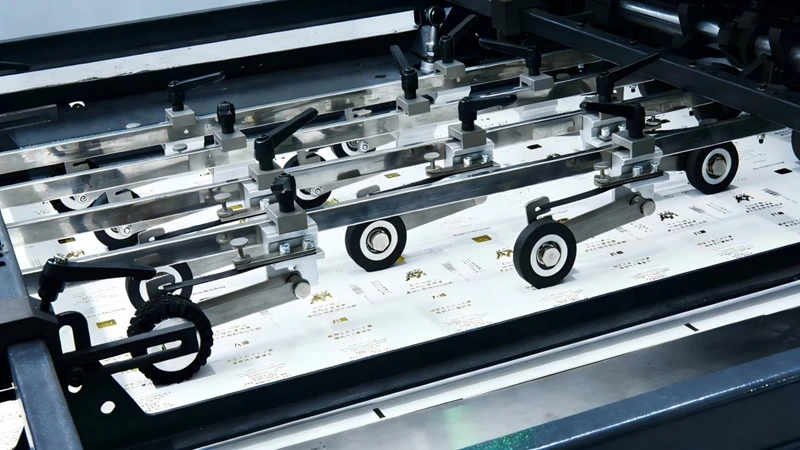
Factor 3: Production Volume and Speed
Production speed is measured in sheets per hour. Different machine models offer different speed ranges:
|
Machine Type |
Typical Speed Range |
Best Suited For |
|
Standard automatic flatbed die cutter |
Up to 9,000 sheets/h |
High-volume, long-run production |
|
Heavy-duty models with stripping |
Up to 8,000 sheets/h |
High-volume with additional in-line processes |
|
Double-unit configurations |
Up to 7,200 sheets/h |
Complex multi-step processes in one pass |
Important: Speed specifications are maximum ratings under optimal conditions. Actual production speed depends on material type, sheet size, die complexity, and operator skill. Buyers should verify performance with their specific materials during testing.
Key question to ask: What is your target daily or weekly output? Match machine speed to your production targets—not necessarily the fastest available, but the speed that sustainably meets your demand.
Factor 4: Accuracy and Precision Requirements
Die cutting accuracy directly affects product quality, especially for products with intricate patterns, strict tolerances and multi-color registration requirements.
DAYUAN flatbed die cutting machines deliver an accuracy of ≤±0.075mm, which meets the demands of most packaging scenarios such as folding cartons, premium packaging and pharmaceutical boxes.
When higher accuracy matters:
- Products with fine details or small text
- Multi-pass processes where registration is critical
- Materials that are sensitive to pressure variations
When standard accuracy suffices:
- Corrugated board packaging where slight variations are acceptable
- Products with generous tolerances
- High-volume commodity packaging

Factor 5: In-Line Capabilities – Stripping, Blanking, and Heating
Modern flatbed die cutting machines often integrate additional functions to reduce handling and improve efficiency.
|
In-Line Feature |
Function |
Benefit |
|
Waste stripping |
Removes edge and hole waste from die-cut sheets |
Eliminates separate stripping step; reduces labor |
|
Blanking |
Separates finished products from waste skeleton |
One-pass finished goods collection |
|
Heating system |
Enables deep embossing |
Adds decorative finishing in same pass |
|
Multi-unit configuration |
Two or three independent stations |
Complex multi-step processes in one machine |
Decision framework:
Basic production → Standard die cutting machine
High-volume with waste removal → Die cutter with stripping
Finished products in one pass → Die cutter with stripping and blanking
Decorative finishing → Die cutter with heating system or hot stamping and die cutting machine options
Automatic vs. Semi-Automatic: Which Is Right for You?
|
Aspect |
Automatic |
Semi-Automatic |
|
Operation |
Fully automated sheet feeding, cutting, and delivery |
Manual sheet feeding; automated cutting |
|
Speed |
Higher (up to 9,000 sheets/h) |
Lower, limited by manual feed rate |
|
Labor |
One operator for monitoring |
One or more operators for feeding and collection |
|
Investment |
Higher initial cost |
Lower initial cost |
|
Best for |
High-volume, long-run production |
Medium-volume, variable runs, sample production |
Semi-automatic machines offer a balance between precision and affordability, making them suitable for medium-volume runs. Automatic machines are the standard choice for production-focused operations where volume justifies the investment.
Common Mistakes in Flatbed Die Cutting Machine Selection
1. Choosing based on price alone. The lowest-priced machine may lack the durability, precision, or features needed for your production profile. Consider total cost of ownership, not just purchase price.
2. Overlooking material compatibility. A machine that handles cardboard well may struggle with corrugated board if the pressure rating or feeding system is insufficient.
3. Ignoring future production needs. If you plan to expand into new product types or higher volumes, a machine that barely meets current needs may become a bottleneck.
4. Underestimating floor space and utility requirements. Larger machines require more space, power, and compressed air capacity. Verify these before purchase.
5. Skipping material testing. Actual performance depends on the specific materials you use. Request testing with your own substrates before finalizing a decision.
Quick Selection Checklist
Before contacting a supplier, prepare answers to these questions:
- What materials do you process most frequently? (cardboard, corrugated, specialty)
- What is your maximum sheet size?
- What is your target production volume (sheets per day/week)?
- What accuracy level do your products require?
- Do you need in-line stripping, blanking, or heating?
- What is your available floor space?
- What is your budget range (equipment + installation + training)?
- Do you have existing equipment that needs to integrate with the new machine?
- What is your maintenance capability and spare parts strategy?
Frequently Asked QuestionsWhat is the difference between a flatbed die cutting machine and a rotary die cutter?
A flatbed machine uses a flat die and processes individual sheets, offering higher precision and better handling of thicker materials. A rotary die cutter uses a cylindrical die for continuous high-speed processing, typically used for labels, flexible packaging, and high-volume runs. Flatbed machines are more versatile for packaging applications with varying sheet sizes and complex shapes.
What sheet size flatbed die cutting machine do I need?
Choose a machine that can handle your largest regular sheet size. Common widths range from 820mm to 2100mm. If your largest sheet is 1060mm wide, a 1060mm model is appropriate—choosing a larger machine adds cost without benefit unless you plan to expand into larger formats.
Can one flatbed die cutting machine handle both cardboard and corrugated board?
Yes, but you need to verify the machine's feeding system compatibility. Corrugated board may need specific feeder types (lead edge, bottom suction, or top feeder). Some machines are designed specifically for corrugated applications. Discuss your material mix with the supplier to ensure the machine is appropriately configured.
How important is die cutting accuracy for packaging production?
Automatic flatbed die-cutting machines can achieve a precision of ≤±0.075mm, capable of meeting the production demands for most packaging products. For products with intricate patterns, strict tolerances and multi-color registration, higher-precision configurations can be provided as required.
What maintenance does a flatbed die cutting machine require?
Regular maintenance includes lubrication of moving parts, inspection of the cutting plate and die, cleaning of the feeding and delivery systems, and checking pressure accuracy. Many suppliers offer preventive maintenance programs. A 300-hour continuous operation test is often performed before factory delivery to verify reliability. For more details, visit the after-sales service and maintenance support page.
Conclusion
Choosing a flatbed die cutting machine requires careful evaluation of your materials, sheet sizes, production targets, accuracy needs, and budget. There is no universal "best" machine—only the machine that best fits your specific production profile.
Start by defining your current production requirements, then consider your future growth plans. Work with the supplier to test your materials on the shortlisted machines. A well-chosen die cutting machine should improve your production efficiency, reduce waste, and deliver consistent quality for years to come.
For a detailed review of available flatbed die cutting machine configurations, visit the flatbed die cutting machine product page. To discuss your specific material and production requirements, contact the DAYUAN team for a consultation.